Independent engineering
From ASCII objects to narrative visual worlds.
Public engineering ↑Content last revised:
An artifact-backed evolution
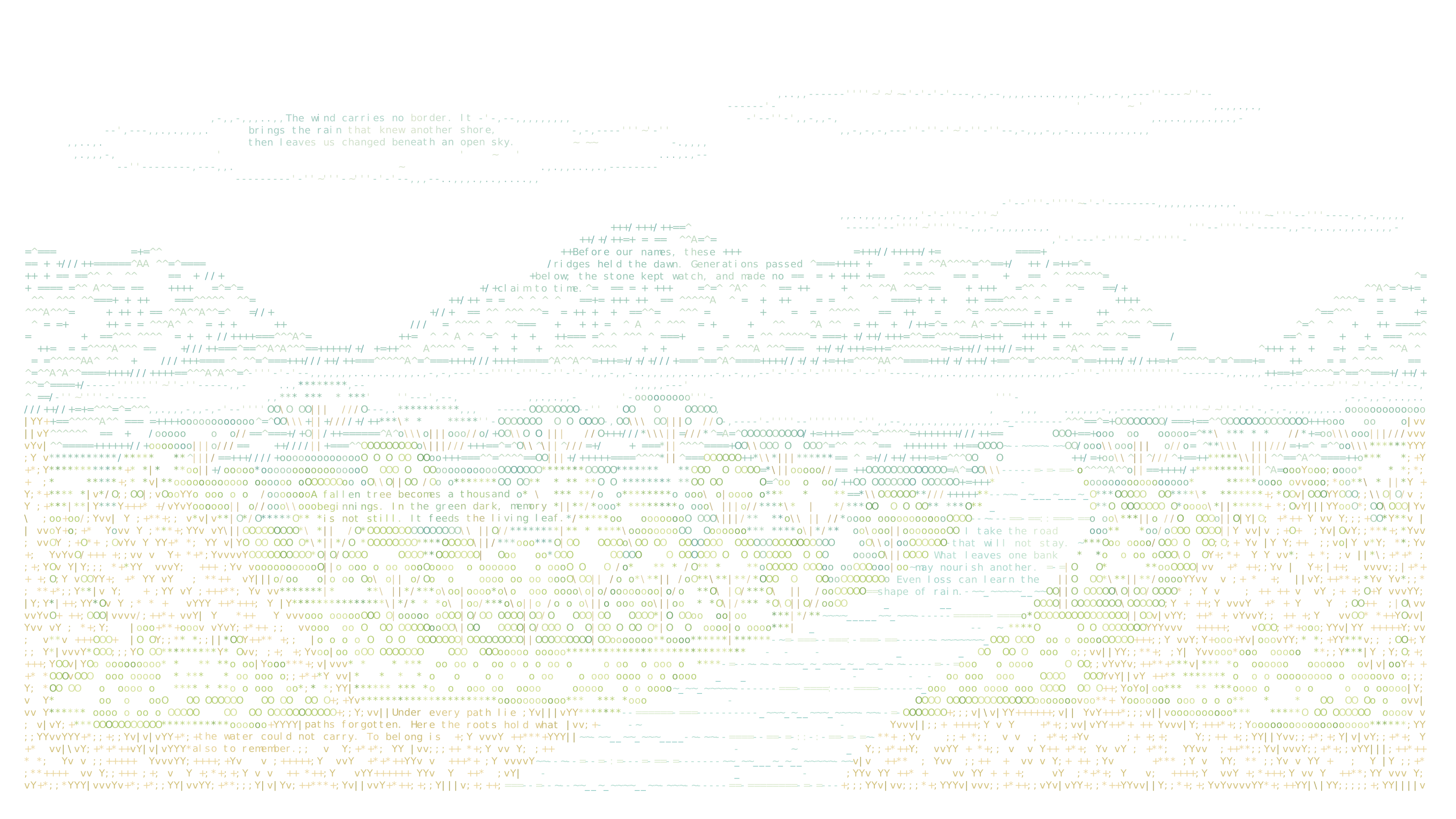
The canonical project name is Narrative ASCII Art Engine. Local documentation describes v0.1 object allocation and v0.2 layered landscapes. Saved v0.2, v0.3 and v0.4 outputs support the comparisons below; no Git history or tags were available to establish release dates.
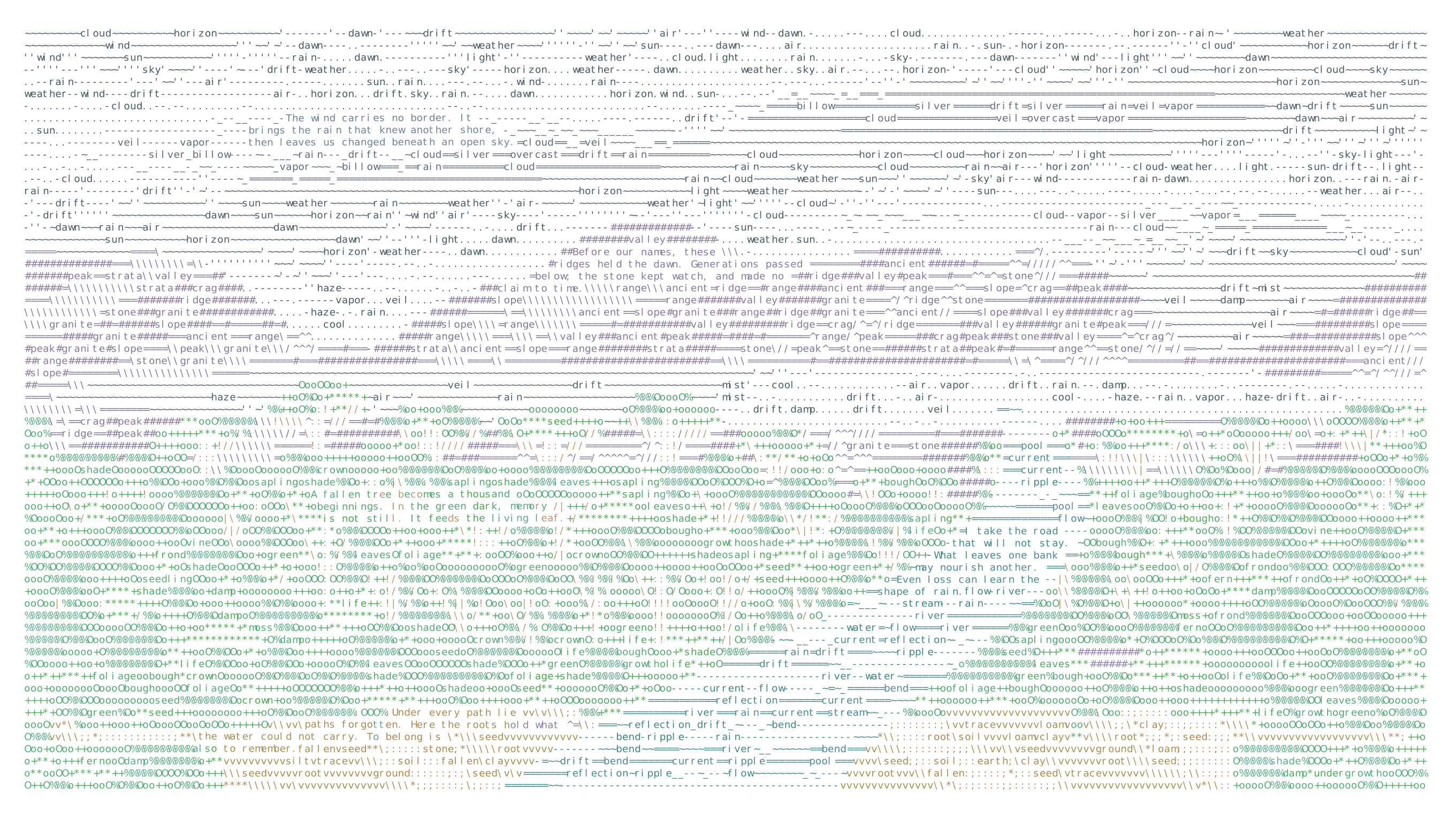
v0.1 is documented as an object-based allocator; no verified v0.1 output is shown. Compare saved stages side by side. Framing and rendering settings differ, so this is not a controlled visual-quality benchmark.
Start with v0.2 and v0.3: layered marks give way to continuous eligible-cell coverage, with intensity controlled separately. Compare v0.4 for the stepped Pixel-Hybrid treatment; different saved settings prevent a controlled quality comparison.
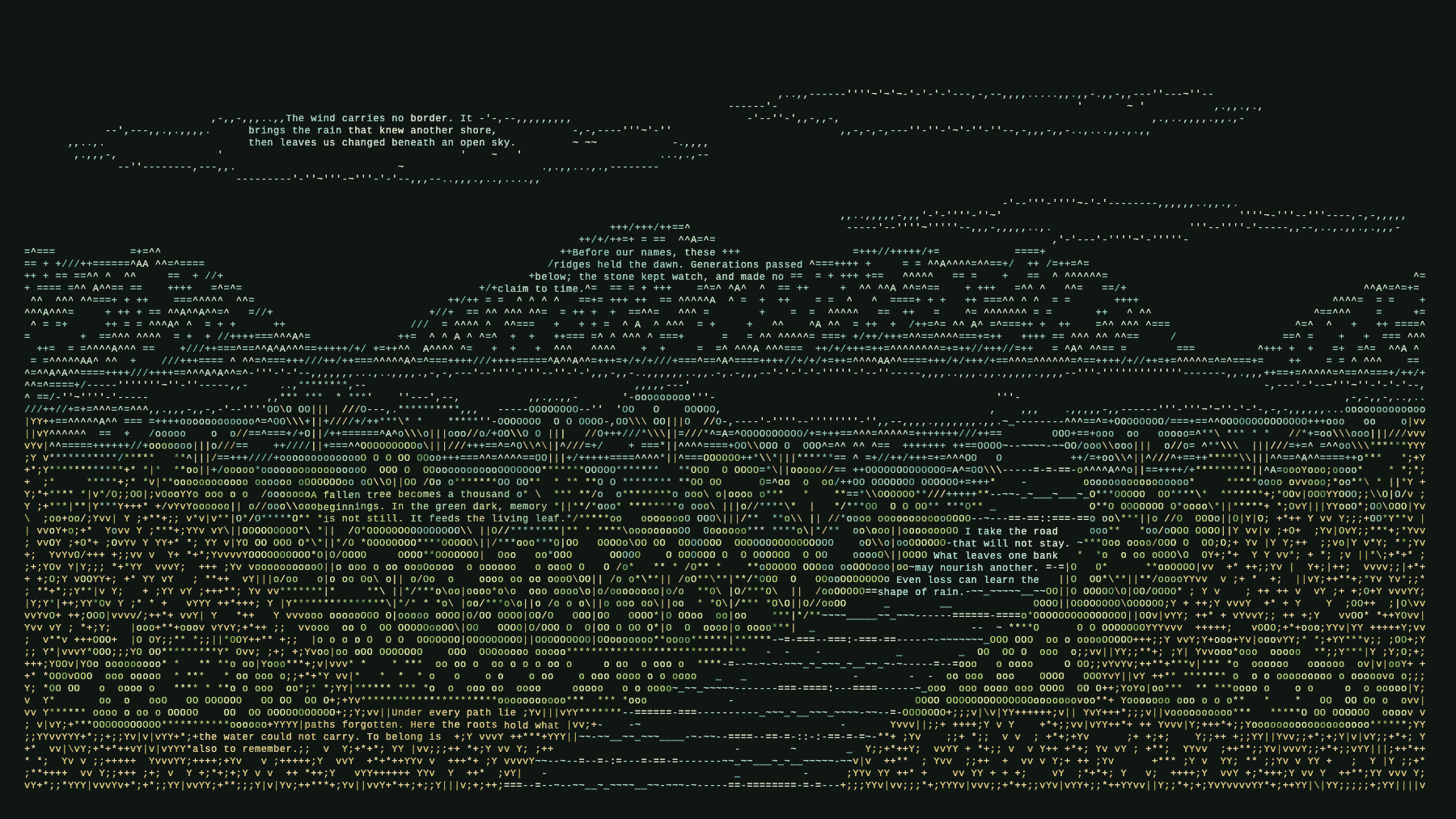
Reproduction configuration
{
  "rendererVersion": "0.2.0",
  "seed": 1842,
  "width": 1800,
  "height": 1012.5,
  "maxTexture": 11000
}
76028f320120e8c05f0a0be52719c78b35a2b53bd96d7aa9009d4374755d3b5b
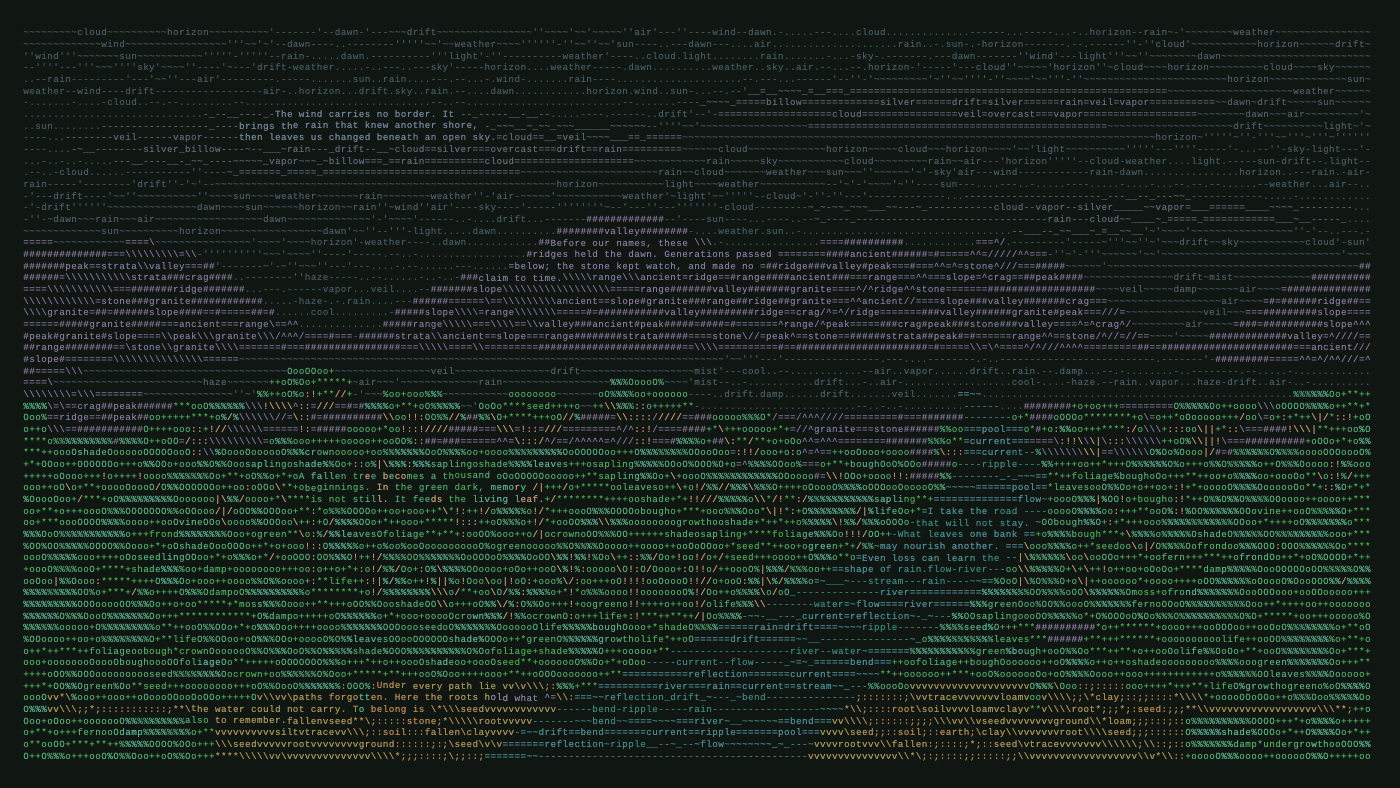
Reproduction configuration
{
  "rendererVersion": "0.3.0",
  "seed": 1842,
  "width": 1800,
  "height": 1012.5,
  "coverage": {
    "profile": "continuous",
    "target": 1,
    "intensity": 0.7,
    "backgroundColor": "#101713",
    "colorVariation": 0.8,
    "textureMode": "mixed",
    "wordDensity": 0.48,
    "atmosphericDetail": 0.6,
    "backgroundDetail": 0.7,
    "foregroundDetail": 0.85,
    "textureComplexity": 0.65,
    "minWeight": 0.015,
    "maxWeight": 0.4,
    "depthContrast": 0.7,
    "narrativeContrast": 4.5,
    "minimumContrast": 2.3,
    "materialIntensity": {
      "atmosphere": 0.25,
      "cloud": 0.36,
      "rock": 0.55,
      "leaves": 0.78,
      "bark": 0.85,
      "water": 0.5,
      "soil": 0.67,
      "shadow": 0.3
    },
    "intent": "digital",
    "fabricColor": "#101713",
    "process": "dtg",
    "detailLoss": 0.25,
    "exclusions": []
  },
  "maxTexture": 30000
}
686923b82a87151704be89f9d93d5e87a625ab3e8cd379e1e1941df7533c513c
Interactive studio — local prototype / public release pending
Protect the story, then compose the texture
- Seeded scene graph → layered geometry and spatial regions
- Physical budget → exact narrative allocation and source indices
- Eligible cells → coverage, semantic glyphs and independent intensity
- Integrity diagnostics → SVG text, PNG and scene configuration
Coverage counts visibly occupied eligible cells; protected narrative spaces are excluded. Intensity controls appearance independently of occupancy. Pixel-Hybrid adds stepped geometry and tile-coherent glyph selection while sharing narrative protection. Diagnostics are engineering checks, not aesthetic quality scores.
The studio/package v0.4 label is separate from rendererVersion: Organic uses 0.3.0; Pixel-Hybrid uses 0.4.0. Scene mode is experimental. Supported text is measured Latin ASCII; physical print quality and a public studio release are pending.
Engineering the Visual Identity: From Narrative Landscapes to Glyph-Based Portraits
A portrait needs recognizable facial structure at a distance and authentic characters up close. Early tonal adjustments could not recover detail missing from the source grid. The portfolio reconstruction therefore works on an existing glyph SVG, not directly on a photograph.
Build-time analysis samples glyph luminance at three neighborhood scales. Font-calibrated ink coverage and local gradients guide bounded size and shape variants while preserving the character sequence. This is source-field analysis, not facial-landmark detection; it cannot invent missing anatomy.
Dark-mode amber supports luminous strokes. Light-mode glyph experiments needed separate ink palettes, tonal mappings and reduced background competition; bright eye highlights and pale small glyphs exposed the limits of palette changes. The current homepage selects a separate illustration in light mode and the reconstructed glyph SVG in dark mode.
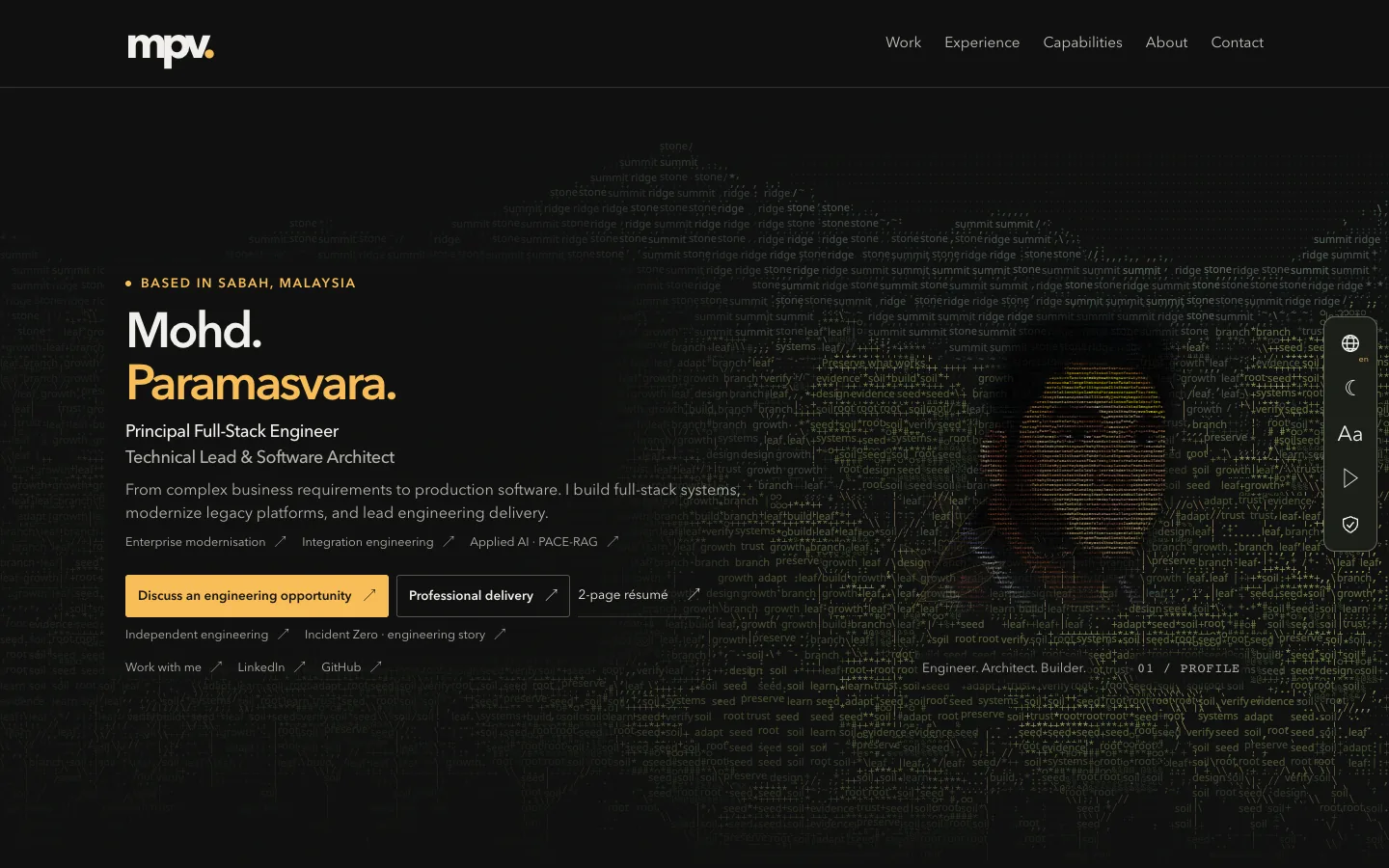
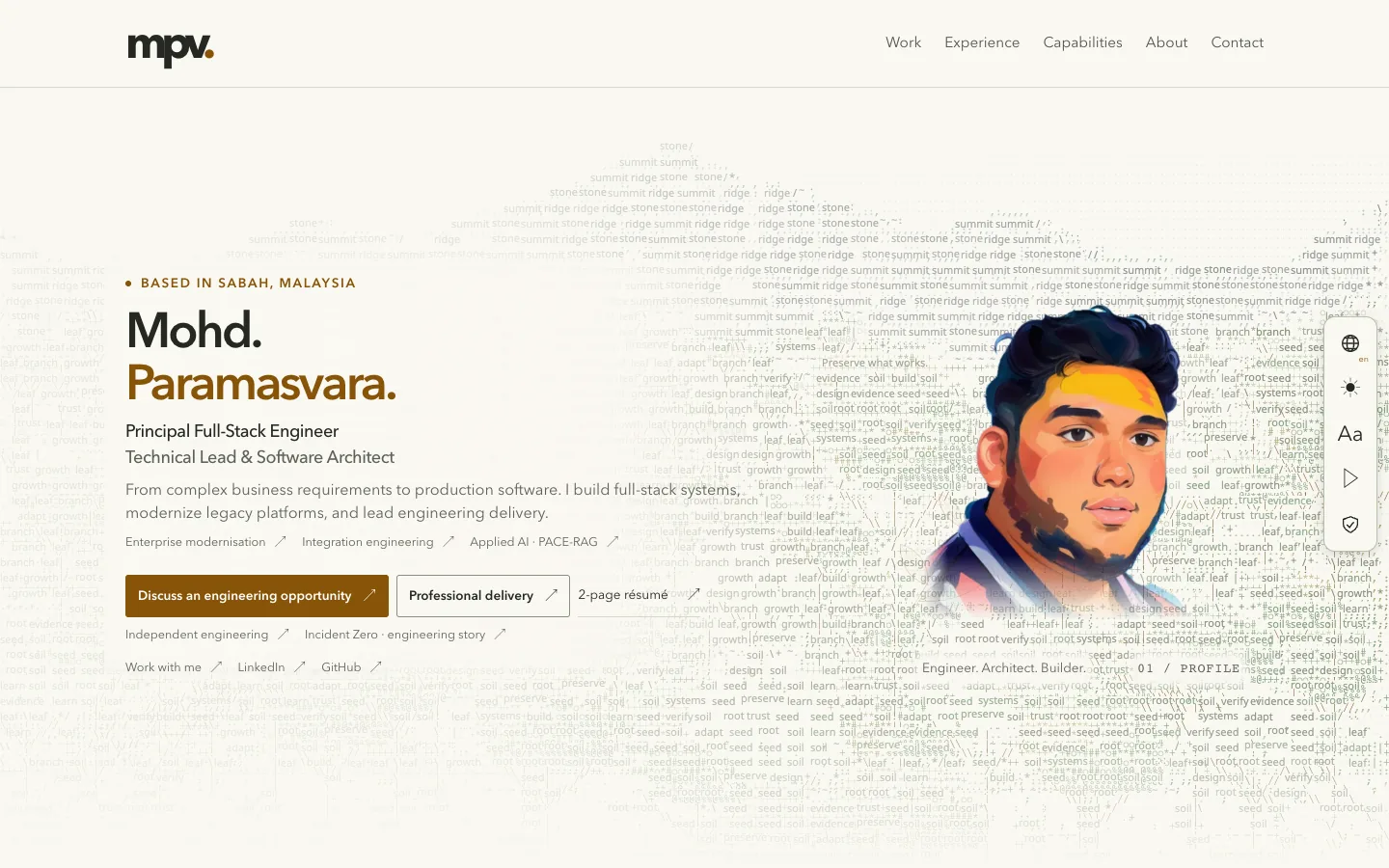
Deterministic reconstruction and geometry tests make the transformation inspectable. These portfolio-specific experiments do not establish standalone NAAE photo support. The captures show current treatments, not a historical before/after benchmark; identity recognition and deployed parity are not independently established.
The Unmapped Path: narrative typography for recovery
The 404 scene applies the same visual language to a useful failure state: seeded SVG-text ridges and a vanishing trail support a localized explanation, quote and recovery links. Compact screens receive a separate composition; decorative glyphs remain hidden from assistive technology.
Static localized fallback documents preserve recovery without JavaScript. Recorded local Pages checks returned HTTP 404 for missing paths and 200 for known routes; this is local hosting evidence, not live deployment verification. The artwork is distinct from the homepage and imports no studio engine.